Tuesday, December 2, 2014

Distorted Damnation

Where do we go when we seek answers to challenging questions? Perhaps news broadcasts, websites, or textbooks hold these sought out solutions to modern dilemmas, but I decided to look elsewhere. I yearned to explore one of the most acclaimed and condemned manuscripts of the last two millennia and decipher its take on the controversial matter of homosexual monogamy. This sudden investigation was spurred by the inspirational preaching of Matthew Vines, founder of The Reformation Project which encourages Christians to support LGBT people. Presented below, his in-depth analysis of various scriptures concerning homosexuality offers a new perspective on monogamy that might cool the conflict between the church and committed gay couples.


Two condemning passages, Leviticus 19:22 and Romans 1:26-27, caught my attention long before Vines had the opportunity to explain his perspective and counter these negative statements. The command, "You shall not lie with a me as with a woman; such a thing is an abomination" (Leviticus 19:22) proved particularly troubling as I struggled to come up with rebuttal to it. Fortunately, Mathew Vines addresses the issue by stating that the old testament law code was fulfilled by Jesus of Nazareth who "is the end of the law for the justification of everyone who has faith" (Romans 10:4). Furthermore, he presents an array of once ridiculed actions so commonly practiced today including charging interest on loans and eating pork to demonstrate the changing of practices through time. The second passage, Romans 1:26-27, as interpreted by Vines, condemns lustful and gluttonous homosexual actions but does not denounce faithful, committed, and loving gay relationships. Ultimately, Vines' context analysis and clarification demonstrates that the Bible neither damns the LGBT community nor supports attacks on them.

If we define sociology as the systematic study of human societies, examining possible shifts in norms and values within this social institution is our fundamental duty as socialists. Discrimination, prejudice, and intolerance against homosexuality has for so long been the institutionalized norm among many cultures. The Christian Church was no exception. "Born gay" and "sinful choice" dichotomy was once a widely adopted characterization of this religious view, and this belief still holds sway over a many people. But today, voices cry out for equality. They proclaim their God's love for all people regardless of sexual orientation, and one need not venture far to find these voices. The Reformation Project is but a single example of a diversity of groups and people fighting for homosexual monogamy within the United States. Even the Catholic Church, an institution once notorious for its anti-gay propaganda, has seen a change in its followers. 62% of American Catholics are in favor of legalizing marriage for same-sex couples according to a New York Times/CBS News Poll conducted February 23-27, 2013. This movement represents the process of resocialization for these preachers, lovers, and teachers. By promoting the legitimacy of gay union, these activists stand against the anti-gay crusade that spawned during the early 1970s, and the adoption of a new system of beliefs, norms, and values constitutes the process of resocialization.

Mathew Vines is not alone in his pursuit of marriage equality. A great deal of followers including members of the Catholic Church strive to make a change to help the persecuted and ridiculed. My title distorted damnation possess two sides. One ridicules the condemnation of other human beings and pleads for the loving acceptance of all people; the other seeks to dispel the idea that a leader's power does not dictate the beliefs of all followers. This blog post is nothing more nor less than a call to love and respect those around you. Neither condemn nor assume others condemn. Search for the goodness of humanity and pursue it.

Victims of Pride?

     After seeing post after post of people rallying for women's rights and equality I found myself compelled to look deeper into the subject. I found many empowering videos on YouTube and Facebook with thousands and even millions of hits and comments supporting the calls to stop domestic violence against women. Then I stumbled upon 2 different videos, one from the UK and one form the US. Both depicted social experiments where men and women publicly fell victim to their partners of opposite sex physically. Both were filmed in largely populated urban areas, the disparity being that the UK video was posted in late May and the US version was posted in September.
     As both videos show, the social norm is to stop violence enacted by a man against a woman immediately. These two videos do demonstrate that the acceptance of male on female violence
 that feminists have striven to reduce over the last few decades has diminished greatly in urban areas. They also show the social norm that it's acceptable for women to beat up and abuse their partners with very little interference while out in broad daylight. I believe there are two key contributing factors to this inequality, one is the concept of masculinity and the other is the social norm that is in place today.
      Masculinity, or the preservation of it, is the reason so many cases of men physically falling victim to their partners go unrecorded each year. Men don't want to admit they've been beaten up or pushed around by women because they're supposed to be physically stronger and better able to protect themselves, based on today's social norms. A lack of action or reaction enables further confrontations and incidences to take place with greater regularity and force just as it happens with women in the opposite situation.
    The other contributor, the norms set in place about what types of contact between men and women are acceptable. If a woman is being assaulted and reacts with violence and defended herself by harming the man physically, its accepted and even encouraged. Every college has a "Woman's self defense class" where they learn to protect themselves from such a situation. What if the tables were turned? And the man who was being assaulted struck back at his perpetrator and punched her out of self defense while in public. I strongly believe that would not be followed by cheers and applause from the surrounding people. Though this is not supported by either video because they did not factor this reaction into the experiment, I still think it would pan out with the man being heckled and possible fall victim to more violence from the people surrounding the confrontation.
      On a side note, the differences in support of the two videos within their own countries is intriguing. The UK video received 6 million views within a month of its posting, the American counter part has only 8,617 in a month and a half (both posters have an similar number of subscribers). This disparity suggests that in America, we are less informed on the phenomena or may simply not care as much about it when compared to the UK.

Tuesday, November 25, 2014

Has Anything Really Changed

Has Anything Really Changed?


An idea and connection came to me in a conversation I had with a friend that involved lynching and how the practice of lynching in America must have made black people feel at the time.  In pictures that you can see not only was this not a hidden or taboo practice in our countries past, but on the contrary these lynching’s seemed to be an institution of socialization in their own right.  They stated, by the unashamed and open participation of so many whites, that white people had the power to do what they wanted because of their whiteness, and also let black people know without a shadow of a doubt that even the institutions that were in place to work for and protect the American citizen, like the police and the government, were not to be trusted.
Racism has a very colorful and ugly past in this country.  And even though things have improved in the last 50 years, unfortunately the problem has grown more and more subtle as time goes by.  No longer can people openly state that they are treating a person differently because of the color of their skin, but does that mean that white people’s actions are not portraying the same images and creating the same feelings between black people and the institutions that are put in place to “protect” them? My idea and argument is that the way our society has normalized the massively disproportionate incarceration of millions of black people along with the killing of black people by the mostly white police force of America has recreated the same dynamic and feelings as the lynching’s did. 


Even though black people only make up approximately 12.6% of the country’s population, they consist of almost half of the prison population today.  According to the NAACP website there are 1 million black prisoners out of 2.3 million totals.  Is this because black people are just criminals and cannot help but commit crimes and therefore must be locked away? To that idea my answer is obviously not, the fact remains that police are searching, finding, apprehending, and locking away young black people specifically and intentionally in their war on drugs. This is a major problem because when you have so many people who are locked up and now have felonies you are disenfranchising them as citizens in the United States and this allows many places in our society to now discriminate against these people not as Black men but now as Felons.  These people have a hard time accessing benefits from the government, finding housing, finding jobs, and cannot vote for the rest of their lives a lot of times.  These facts alone serve to create a non trusting and splintered relationship between black people and the “system”. When you couple that with the fact that white police officers are not only looking specifically for black people to lock up but that they are killing on average 2 black people per week per year with little to no consequence, it is a smack in the face for many black people around the country. 
The reality of the race situation in our country is that while it is not politically or socially correct to speak openly about racism, that it still exists and is alive today victimizing and creating the same kind of distrust and divide as it did in the 1800s and early 1900s.  In too many places in our country black people do not see a friend or protector when it comes to the police and the government.  Instead what many people see is another potential enemy who can do what they want and even kill without serious thought of reprimand.  Imagine what life would be like if you felt that way about the very people who were paid to protect and serve you.  How would that change your life?

Sunday, November 23, 2014

Russia Punishes the West, Damages Self, Incites Change.


In response to sanctions from Western countries against Moscow, Russia banned the import of many food and agricultural products in August. The prime minister of Russia announced that they would ban all beef, pork, fish, fruit, vegetables and dairy products from the European Union, the United States, Canada, Australia and Norway for one year. Aside from the United States, Russia is the largest market for European agricultural exports, last year summing up to about 15.7 billion dollars according to the European Union’s statistics agency. In the short term finding new suppliers will be difficult for Russia. With Putin’s approval rating at 87% he isn’t facing dissent for this action. Some consequences of the sanctions include an increase in food prices, Inflation rising to 8.3 percent. Prices for meat and poultry rose more than 18 percent and dairy prices are up by over 15 percent, according to Russia’s federal statistics agency. Despite these facts, the Russian public for the most part supports the sanctions, possibly as a result of effective propaganda run on their televisions.

30% of Russia’s population earn their living from agriculture or related industries. Before the sanctions these people were urging for an emphasis on local goods. As an unintended consequence of the ban on foreign suppliers many local farms and businesses have received the opportunity to be successful. Ten percent of chickens sold in Russia came from abroad, mostly the United States. The sanctions were very useful for local producers who no longer had to compete with America’s low prices.

Most noticeably, the sanctions produced a change in the mindset of the citizens with an increased awareness of the origination of their goods, as well as the rise of a social movement. The sanctions spurred desperation in many major Russian grocery chains. Clamoring to stock their shelves, they began to turn to farm to table organizations like LavkaLavka.  This organic farm cooperative doesn’t produce nearly the amount of food the grocery chains need but the attention given to them is vital to the spread of their ideology. The sanctions are giving a chance for local farmers to develop and sustainable agriculture to grow. Increasingly, the public is considering where their food comes from as a result of the sanctions.

Ponomarev The New York Times, Sergey. Boris Akimov, who runs LavkaLavka, an organic farm cooperative, hopes that with the ban on Western imports, Russians will explore local foods. Digital image. N.p., n.d. Web.

Some citizens hope the sanctions last long enough for Russians to become knowledgeable about the food their country produces as opposed to finding new suppliers to replace the banned ones. LavkaLavka has begun a monthly food festival celebrating something local each month. The month of November celebrated the Parsnip.


The citizens of Russia’s everyday lives were impacted by a large societal process. From a sociological perspective, the increased awareness of the citizens towards local goods as a consequence of global politics is an example of a macro-micro connection. On the macrolevel of analysis lies the politics between the countries and their incentives for imposing these sanctions. The interactions of the nation’s governments, which are in themselves large social structures, is an example of a societal and historical process. These sanctions resulted in a change in ideology in the citizens which would place it on the microlevel of analysis.  The people of Russia’s new consideration of food and where it comes from was a direct result of the interrelationship between the macrolevel societal forces and microlevel everyday processes. 
Video: Siberian farmer is ecstatic he can sell his mozzarella now that Italy is out of the market.

Friday, November 21, 2014

This Battered Woman Wants to Get Out of Prison


“This Battered Woman Wants To Get Out of Prison”


I was reading through BuzzFeed as I do a lot to waste time and came across this article. I was wondering if the battered woman had been battered before or after she had been put into jail, what her story was, and it turned out to be a very interesting as well as aggravating one.


This article tells the story of a man, Robert Braxton, sentenced to two years in prison for breaking the femur and ribs of his 3-month-old daughter and his wife, Tondalo Hall, who was sentenced to 30 years in prison for not intervening on the abuse he was enacting upon her daughter - even though she never actually caused any physical harm to her daughter.


There was also evidence proving that Hall was also being violently abused by Braxton herself.


Seems unjust, doesn’t it? Agreed.


It turns out that, according to BuzzFeed News, there are at least 29 states with laws that criminalize a parent’s failure to protect their children from abuse. It’s known as injury to child by omission in Texas and as “permitting child abuse” or “enabling child abuse” in other states. There is an understanding that a mother is responsible for her child’s safety - this is something I agree with, but these laws against parents make them responsible for what they did not do and they often place more blame on the parent who failed to seek help rather than on the one who enacted the assault.


The case of Hall and one’s like it bring up a great number of inconsistencies and inequities that exist in our society today. To begin, we can talk about what cases like this say about gender roles.


While most cases of domestic abuse are committed by a father or stepfather, it’s a fact that 34% of cases of child abuse are enacted by women. However, interviews and BuzzFeed News’ analysis show that fathers in very rarely face prosecution for failing to stop their partners from harming their children. Through their studies, BuzzFeed found about 73 cases of mothers who were sentenced to ten or more years under permitting child abuse laws while they found only about four in which fathers were sentenced for the same thing.
It rings true that women bear the weight of these laws. A law professor at the University of Denver reflects on this truth saying “Mothers are held to a very different standard...the lopsided application of these laws reflects deeply ingrained social norms that women should sacrifice themselves for their children.” So what about the fathers? Reading through this article, I find myself asking questions like “why is it that the mother is sentenced for more time in prison for not stopping the abuse executed by her husband? Shouldn’t the father be sentenced for more time for actually perpetuating the abuse?” The father should have the same expectation to protect his child as the mother does, but, for some reason, that expectation is not applied to the father in the same way as the mother in many of these cases.


The fact that Hall was sentenced to more time than Braxton was enforces the very confusing idea that, to some extent, what he was doing to his child is deemed as OK, but her not intervening was much less OK.


“Her tough sentence was meted out despite evidence that Braxton had also been violently abusing her. In statements to authorities in and out of court, and in a recent interview with BuzzFeed News, Hall described Braxton choking her, punching her, throwing things at her, and verbally assaulting her. Even the judge who sentenced her said that during her testimony, Hall seemed to fear her boyfriend.”

There is also a conversation to be had concerning the fact that in many of these cases, the mothers were also being physically abused by their husbands/boyfriends. The biggest reason that they are persecuted under the charges of failing to intervene on their children’s abuse is because, as many attorneys say, “she should have called the police, she should have gotten out of the abusive relationship before she let it get too far.”  


These kinds of cases bring up a common misunderstanding of what it means for women to be trapped in abusive relationships. There is a kind of unspoken culture that exists among women who are victims of domestic violence. From the outside looking in, it may seem silly and irrational that a woman would not do everything she could to get out of the violent relationship that she’s in. However, it seems to be very different for women who are actually in these relationships. Many women reflect on how they wanted to leave, to call the police, to ask for a friends help many times but when they did, it only made their partner angrier and more likely to harm their them or their children.


This whole story and one’s like it are blatant instances of victim blaming - something that seems to exist in multiple corners of our society. Women are in dangerous situations in which they face physical and mental harm to themselves, and then many people put them at fault when they did not leave the relationship. There is some idea that suggests that it’s their fault for not taking a stand against their abusive partner. This makes me ask questions like why are we paying more attention to the fact that a woman didn’t run away from her abusive relationship, rather than the man who is abusing his partner and children? One could possibly make the argument for men in terms of masculinity. It is understood in our patriarchal society that men should be strong, should be dominant, and should be the leaders in the home. Is the reason that we lend so much slack to men in these situations because, as far too many people still say, “boys will be boys”? Because that is not at all a strong argument, nor is it true.


Based on this case and ones like it, I would like to argue that there needs to be more light shed on the abusers role in abusive relationships and what we can do to punish them. I also believe that these enabling child abuse laws need to be re-looked at because it seems that they are causing innocent women who are often also victims to be punished rather than the person who is causing the actual harm. This is unfair and it is contributing to the patriarchal society already in existence.

Thursday, November 20, 2014

The Key to Happiness

Happiness is a deceptively complicated thing.

How many people do you think are really, truly, happy? And does this have anything to do with where you grew up or currently reside?

The United Nations passed a resolution in 2011 that looked into the Gross National Happiness (GNH) of different countries. The idea here is that this knowledge will help policy makers decide how they can improve their country or what they need to work on. But it's more than that.

This data further shows what our societies really need, regardless of what we want. Many in our society have aspirations to become wealthy, loved, and respected. These things are desirable because they are thought to correlate with happiness. As happiness is hard to quantify, no one really knows how to get there. You cannot ask for directions, you just have to do your best.

From that another important question arises: how do you measure GNH?

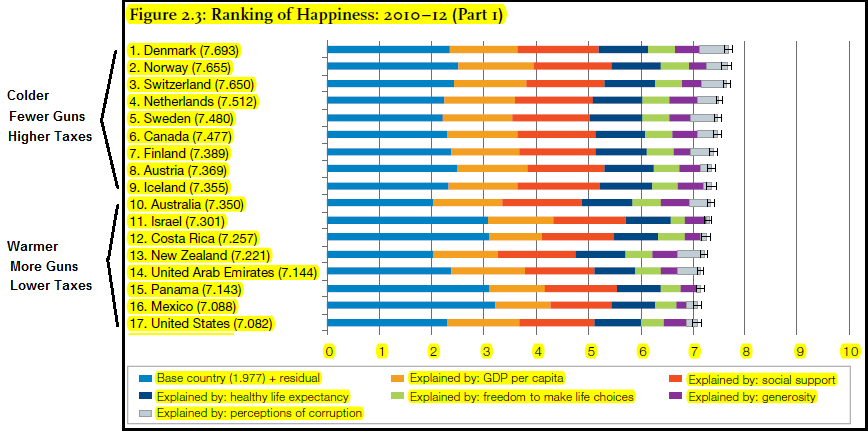
This graph below shows seven different criteria that were deemed important in contributing to the happiness of a nation, from GDP to generosity. Each one is likely to contribute to happiness, so the country with the most all together would be the happiest place to live.

Source: World Happiness Report 2013

The diagram goes further to point out similarities between the top half and bottom half of the list. Apparently a country is more likely to be happy if it is cold, has less guns, and higher taxes . The cold is likely a spurious relationship (what effect would weather have) but less guns would likely mean less violence (and therefor less fear and stress). However, I think the difference in taxes is the most important factor because of the implications carried with taxes. Higher taxes are usually different between socioeconomic strata, which means that the wealthier are taxed more. This decreases the wealth gap and helps those who cannot fully support themselves. It also prevents the wealthy from getting self-obsessed and greedy about their money.

A parallel problem with low taxes is the individualist culture that usually accompanies it. For example, in the United States we are taught that we have to work for everything we have, and in that way we earn it -- fair and square. Right? Wrong. Not everyone has the same opportunities or outcomes even if they work just as hard as their peers. The belief that the homeless are just lazy or gave up is ignorant to the inherent inequality in our societies; we should be compassionate and helpful instead of snobby and self-important.

The top few countries on the happiness scale are overwhelmingly Scandinavian. These societies have fantastic welfare systems that aid those in need. It also leads to a culture of helping out your neighbor, instead of screwing him over for your own personal gains. If we worked for our community instead of ourselves, where would the United States be on that list today?

Wednesday, November 19, 2014

Fifty Shades of Gay


The video above is about the spectrums of sexuality. One of the key points that iO Tillett Wright is trying to get across is that sexuality cannot be placed in boxes. Our society loves categorizing people and placing labels on them, and without labels, we tend to feel more uncomfortable. Labels are put on everything: politics, relationships, sexuality, gender; we even put labels on people based on something so simple like whether or not they seem dangerous. All of these labels end up leading to advanced judgement and fear of other people who are "different" from us. This is something that many people across the board are working hard to combat.
iO Tillett Wright is, a photographer, artist, actor, writer, filmmaker, activist, and director, and she is attempting to humanize the idea of sorting boxes in our heads. Her goal is to get across the idea that we are all people regardless of how we might be characterized, and sometimes the things that cause judgment are not openly visible. In her earlier years she spent one year photographing young women who felt like she did: not belonging anywhere, even in the socially-granted boxes. All of these women that she photographed felt as if they fell somewhere along the LGBT spectrum.  She took photographs of these women to prove the point that girls could look anyway that they want and that they can be attracted to anyone based on personality and not based on gender or sexual orientation. iO Tillett Wright was raised in a neighborhood where being gay, being a drag queen, and being a tomboy was considered normal. She realized later that she was lucky because she felt safe and always appreciated but, she also realized that she was considered part of a minority. She soon decided that she wanted to make her project on photographing women bigger and broader.
She began taking photographs of any single person who felt that they were anything other than 100% straight. Society likes to box up sexuality. If you are a guy dating a guy people will automatically ask, “Are you gay?” Or vise versa; when a girl is dating a girl they are immediately tagged as a lesbian. However, what happens when a girl dates a guy and then her next partner is a girl? Does that automatically make her 100% bisexual? The idea of a spectrum of sexuality scares people because then they don’t know where anyone fits in society, an idea that is so painfully unnatural to so many people. People feel the most comfortable when they tag others and say, "You are gay, and you are straight." It's important to keep in mind that not only openly queer-identifying people are put into boxes. Plenty of "straight" people are put into that box as well. Why can’t the idea of loving people be accepted?One of the key points that iO Tillett Wright is trying to get across is that sexuality is a spectrum and there’s a million different shades.
At one point she asked people to place their sexuality on a scale of 0-100% gay and people almost didn’t know what to do because people didn’t know what to do with the option of being open about their sexuality. A good example of the open “boxing” is when a boss can fire an employee for being homosexual. But where is the line drawn between being "straight" and being "gay" if those people cannot even identify it for themselves? Is one girl considered homosexual if she happens to kiss another girl on one occasion? Is she considered a lesbian now and can she now be fired for that? There are so many shades of sexuality that putting someone in a box simply doesn’t work.