Sunday, December 10, 2017

A Critical Examination of Sustainibility


The concept of sustainability, and the rhetoric surrounding it, has captured the attention of the public, with good reason. It’s simple, vague, and promises a bright future that requires little sacrifice of comfort or convenience. The idea of sustainability responds to very valid anxieties within the public sector about human-suffering due to environmental issues. It allows us to imagine a beautiful utopian future that can be achieved by practicing conscious consumerism. This idea disregards the realities that we will face in the future due to global climate change, and the amount of work it will take to substantially improve humanity’s relationship with the earth. Sustainability is a complicated and often misleading label. Critically examining the blanket concept of sustainability in order to compose a clear picture of it, unearths many contradictions to the values of the sustainability movement.
If they have the means, consumers will pay more for products marketed as greener or eco-friendly. In return, they receive the comfort that they made the conscious choice for the health of themselves, their families, and the planet. Marketing companies are acutely aware of this, so the label of “sustainable” becomes a badge of the higher class, a symbol of safety, and an effective marketing ploy. The label of sustainable on food products addresses anxieties that are beginning to form within certain sectors of the public around treatment of workers in food production, genetic modification, pesticide use, and the future of agriculture.
Sustainable agriculture practices seek to address these fears. Agronomy for Sustainable Agriculture: A Review states,
“serious terrestrial issues about food show clearly that conventional agriculture is no longer suited to feeding humans and preserving ecosystems.”
While sustainable agriculture seeks to fix perceived flawed systems in production, it also leaves questions to be answered about whether the solutions is presents are truly effective on a large scale.
The effectiveness and implementation of sustainable agricultural practices is very difficult to quantify. No-till agriculture is a popular alternative to conventional agriculture that is thought to increase soil fertility and crop yield, while sequestering carbon in the soil. It is commonly associated with environmentally focused intentions described in the New York Times op-ed piece Soil Power! The Dirty Way to a Green Planet. According to the Food and Agriculture Association, no-till agricultural practices are being used on up to 70% of cultivated areas. However the application of no-till agriculture is not synonymous with eco-friendly. In his book “Soybeans and Power” Pablo Lapegna explains that farmers who grow Genetically Modified, pesticide resistant soybeans have no need to till the soil due to the mass quantities of harmful pesticides that are used to kill weeds. The goals of farmers who use no-till agriculture as a technique to increase soil fertility and reduce atmospheric carbon levels are substantially different that a farmer to does not till his field because he kills his weeds with chemicals. However both practices are named “no-till agriculture”. Although no-till agriculture has been labeled “sustainable”, the reality of it is much more complicated. When used in the right way, no-till agriculture truly has the potential to sequester substantial amount of carbon in the soil, increase crop yields, and reduce flooding and erosion. However conventional agriculture and no-till agriculture can have equally positive or negative effects on the environment depending on what context they are used in.
There are many inconsistencies within the discipline of “sustainability”. In What on Earth Is Sustainable? Miriam Greenberg comments on the holes in the sustainability movement.
“The movement pursues many of the same, relatively narrow sustainability goals as alternative food. This includes a do-it-yourself focus on localism and small-scale farming, rather than on broader injustices within the California food system such as workers’ exposure to toxic chemicals, chronically low wages, and expanding informal settlements in the agricultural belts of the Central Valley and Imperial Valleys—where the most rapid urbanization in the state is occurring.”
Much of the sustainability movement takes the treatment of humans and animals for granted. Those who support it buy meat products that are labeled as free range, cage free, or grass fed. These labels can be very misleading. For example, cage free often means poultry is kept in cramped huge warehouses with poor ventilation and hardly any room to move. Yet the absence of cages allows meat to acquire a label that suggests it the animals were raised humanely. Regarding workers rights Greenberg states,
“Perhaps not surprisingly, environmental justice outside of the Bay Area—in eco-dystopian Southern California and the Central Valley—has been more linked to the labor movement and more engaged in farm worker and environmental health issues.”

Sustainability movements shift character and focus based on their location and the populations that support them. They are constantly developing and changing. Positive changes have undeniably risen from the sustainability movement. However we must remember it is not the be-all-end-all solution to our environmental issues. Moving towards some idea of “sustainable living” is not a worthless pursuit. However we must keep in mind the complexities and inconsistencies that undermine it and continue to develop new and better way to live on this planet.

Lapegna, Pablo. 2016. Soybeans and Power: Genetically Modified Crops, Environmental Politics, and social movements in Argentina. New York: Oxford University Press.

One's Self-Discovery is Another's Label

One can do a quick Google search today and be presented with countless different tests that will supposedly reveal your inner self. There are those that reveal your personality type, strengths, weakness, leadership skills all the way to suitable careers and many more. Each test relies on different procedures that range from responding to a set of statements on a scale of how applicable a statement is, to describing inkblot images whilst the test administrator records your every word and action.
What do you see in this image?


While there may be some evidence that personality tests have some use to the individual in their personal journey of discovering themselves or in the case of the Rorschach test; finding out one's psychology, there isn’t much discussion about how such tests affect the broader society. In some cases, it appears that these personality tests may be causing more harm than good.

Probably one of the most well-known personality descriptors is the introversion/extroversion scale. People everywhere seem to know about it or use it in their daily conversations to describe themselves or others without second thought. According to 16personalities.com, “introverted individuals prefer solitary activities and get exhausted by social interaction” while, “extroverted individuals prefer group activities and get energized by social interaction”. While there are a number of slightly different definitions to these terms, the label of the ‘extrovert’ and ‘introvert’ has clearly stuck in the minds of most people along with the idea that the label carries.


Assuming that these labels actually do correspond to a real inherent personality trait that is distinguishable, the ideas and meanings associated with these labels are socially constructed through social interactions, the media and institutions such as the workplaces, schools and even in the home. Since these labels include a behavioral expectation, labeling theory kicks in and individuals internalize these labels. With time and personal experience, a cycle begins in which a person labelled as an introvert behaves more and more as an introvert, thus reinforcing the label and its effect on the person’s life. 

Consequently, these personality starts working as process, stratification and structure similar to Lorber’s view of gender as process, stratification and structure. First, personality tests create the distinction between extroversion and introversion. As these labels become increasingly utilized in society, they are internalized and reinforced. Extroverts, due to their traits, are seen to be better and more able to function in our modern society while introverts are often misunderstood. Ultimately, personality types become a structure that gives more power to extroverts than to introverts. As this article suggests, extroverts dominate public life in almost every sphere due to their traits while introverts may be criticized and called timid, haughty, proud, loner and reserved.


So, the next time you take a personality test, remember that most of the meanings associated with both introversion and extroversion are nothing more than what society as a whole associates with those labels. Perhaps, it may be better to avoid these tests and pick up a book that presents a clear description of all the different personality tests to avoid the cyclical effects of a label. And finally, think twice before calling someone or yourself an introvert, or an extrovert for that matter. You’re only reinforcing the label.

The War on Truth: The Shifting Beliefs of the Republican Party Regarding Climate Change

For many individuals, scientific discoveries are accepted as facts, not as lies, conspiracies, or "fake news." These strongly held beliefs in the legitimacy of science, especially regarding the topic of climate change, were previously widely accepted as facts by all political parties. There has recently been a shift in the beliefs of the Republican Party, and I am setting out to investigate why. 

To the surprise of many, Republicans in the 2000s widely accepted the fact that climate change is real. To illustrate this, in Mitt Romney's bookNo Apology: The Case for American Greatness, published in 2010, Romney writes, "I believe that climate change is occurring–– the reduction in size of global ice caps is hard to ignore. I also believe that human activity is a contributing factor." 
Romney openly believed in climate change, and he was even willing to acknowledge that human activity contributed to its growth. Although he strongly believed in this, his views changed in 2011. 

Although he still believes in climate change, he now does not acknowledge that humans are its main cause. Romney says at a 2011 campaign event, "My view is that we don't know what's causing climate change on this planet. And the idea of spending trillions and trillions of dollars to try to reduce CO2 emissions is not the right course for us." Romney, along with many other Republican politicians, switched his views regarding climate change.

Even strong conservative Newt Gingrich voiced his support for working against climate change, stating in a 2007 debate, "The evidence is sufficient that we should move towards the most effective possible steps to reduce the carbon loading of the atmosphere." 

Although his stance was strong, like Romney, Gingrich's views changed with time. Gingrich later states in 2008, "I do not know if the climate is warming or not. There is some evidence the larger impact of the sun may be about to send us into a long cooling period." 

As can be seen, Republicans widely believed that climate change was real and could be attributed to human activity. Their opinions shifted as time went on. The real question is why?
Republican Senator McCain brilliantly discusses the reason for this shift in opinion and the lack of progress, stating, "It's the special interests. It's the utility companies and the petroleum companies and other special interests. They're the ones that have blocked progress in the Congress of the United States and the administration." 

Some individuals within the government side with large oil corporations because they are able to benefit from denying climate change, while others deny the science behind climate change due to political polarization. Many Republicans switched their stance on climate change shortly after Obama's election. Denial of climate change is now a popular Republican viewpoint to hold due to the polarization. As reported by the New York Times, according to Republican strategist Whit Ayres, "it's become yet another of the long list of litmus test issues that determine whether or not you're a good Republican."

Although scientific evidence regarding the proof of climate change has been growing stronger, Republicans' views against its legitimacy have been continuing to grow. Many individuals are willing to believe in things that people in power say. According to an in-class lecture, physical facts are shaped by a "social construction process". There is a lot of rhetoric within the United States about the validity of climate change, which is leading individuals to construct different beliefs. When many politicians begin to disagree with the legitimacy of climate change, their supporters begin to follow.


This change in public belief, which has been largely influenced by politicians, is seen in a New Hampshire study performed by survey researcher Lawrence Hamilton. According to this study, there is a bigger partisan divide over climate change and whether environmental sciences are trustworthy than there is over abortion and the death penalty.


Hamilton, 2014

These results are quite surprising, because the reality of climate change is based on scientific fact, not public opinion. Although this is true, it is clear that many people perceive that climate change is something that can be disputed and disagreed about. With the growing polarization in the United States, will this war on truth ever end?


What Ignorance Does: Transgender Visibility

On December 7, 2016 Danica Roem became the first ever transgender person elected to state legislature. A few weeks later the Virginia GOP announced that they wanted to begin using non gendered titles when addressing delegates. While House Leader Kirk Cox, a republican, said that this move was being thought about for a long time and that it was time for this to occur. Interpreted by many to be an attempt to invalidates Roem's womanhood and to specifically allow them to not call her a woman. However, the GOP failed to realize that a non gendered title is beneficial to non binary people, since it removes the awkwardness of having to correct people or having to challenge people who purposely misgender.

Why were these law makers so uneducated about a subject that they want to fight against? This question comes up again and again when discussing transgender rights.  Although this topic may seem fairly new and foreign to some transgender people have been around for as long as people themselves. For most of recorded European history individuals who did not adhere to the gender binary were ridiculed or shunned from society. As time went on these people kept on being pushed down by European society until it seemed as though they no longer existed.

So this prompts the question of why are we seeing transgender people now in everyday society. Why is Danica Roem winning elections, why is The Switch, a sit com about transgender people living in Vancouver, becoming popular? One option is just time. The collective rebellion over thousands of years finally coming out and triumphing. Another is changing perspective on gender with cisgender people. Judith Lorber writes in “Night to his Day”:The Social Construction of Gender, "gender, like culture, is a human production that depends on everyone constantly 'doing gender'". This ideology has become more pervasive with time resulting in the world we have now. In my opinion the most logical option is the slow disassembly of imperialist Western culture. When Europe, and later on America, began colonizing the world the invaders destroyed and ripped apart the native cultures. In what would become California, Spanish missionaries killed any Native Americans who did not do the work that was associated with their sex. This created a world in which the only ideology was the Western one. As time went on ideology, and more importantly what was societally acceptable, changed. It was no longer allowed, in the classic sense, to kill anyone who did not follow the same mindset as you. Now rights for marginalized groups could explode outward and create a society in which these people were not murdered everyday. This made certain parts of what was considered normal to collapse, but only in certain locations were laws actually changed and these people congregated. When transgender people grouped together they forced people to learn and acknowledge them. However, in places like Virginia, where Danica Roem is from, the past societal constructs were still in place due to a lack of knowledge on these people. This resulted in a dichotomy in which transgender individuals were hidden in the eyes of the media and the everyday, but were living their lives in cities. As time progressed trans people gradually became more public as they became involved in ads, writing, and just life. Thus we have the society were we live now were Roem can go to the American Music Awards with Demi Lovato, and yet still be attacked and pushed down by her political adversaries.

No means Yes...Unless a you're looking for Justice

      As 2017 comes to a close, the United States media has contained a plethora of stories concerning rape and assault victims who have forward to discuss their experiences. Many high-profile celebrities have been accused of terrible crimes, with victims’ narratives containing traumatizing and debilitating events that have altered the course of their lives forever. However, as these brave survivors have stepped forward to share their stories, many have questioned why they waited such a long time before reporting these occurrences.
      After any crime occurs, most assume that the next logical step is to report it to the police, eventually resulting in the arrest of the assailant. For victims of the crime of rape, however, this process can look very different.
      Rape, unlike other crimes, carries many social stigmas and stereotypes that present challenges for victims at every level of investigation, prosecution, and recovery. For example, cases of rape have one of the highest levels of unfounded rates among any person on person crime. An unfounded case refers to the incidents when police choose not to pursue prosecution for “various reasons,” such as lack of “substantial evidence or a baseless claim.” As discussed by Jody Raphael in her book Rape is Rape, a study conducted in 2008 found that while 1.5 and 1.0 percent of burglary and robbery cases were deemed unfounded, rape cases were almost six times that with 5.8 percent of all rape cases resulting in an unfounded status.
Photo Courtesy of Buzzfeed

      This data shows a clear barrier that arises when police, and society in general, are faced with cases of rape. The problems first arise in relation to George Herbert Mead’s Symbolic Interactionism Theory. Rape has evolved to carry a very stigmatized meaning, which alters the way police would traditionally approach a crime. When police are first presented with a case of rape, they are immediately reminded of all of the symbolic stereotypes that surround the crime, such as assuming the victim acted in a particular way to provoke the attack. These meanings are derived from the interactions with others and the social conditioning that occurs while living in a society that promotes rape culture (9/7 Lecture). As a result the various stereotypes tied to rape, the police will assume the claims to be unfounded, furthering the negative perceptions of the crime.
      Because we are living in a rape supportive society, all people, including police officers, have been socialized to dismiss rape and distrust (9/14 Lecture). One aspect of the unwritten rules of rape culture that individuals learn is to constantly question the validity of rape victims claims. Victims are never to be fully trusted and are often treated as if they are on trial, rather than the assailant. This reality could explain the high numbers of unfounded rape cases as the police have been conditioned to disregard the claims of victims. They then possess a propensity to view victims’ allegations as baseless and be less motivated to collect evidence.
      Rape culture is deeply entwined in all areas of society and this reality only grows worse as more individuals are socialized to find rape acceptable. This, as well as the symbolically charged nature of the concept of rape, creates many issues for victims in pursuit of justice, as seen with the rates of unfounded cases.

Race in the Media: The Progressive Solution to White Supremacy


A main argument presented in the New York Times bestseller The New Jim Crow is that “In the era of color blindness, it is no longer socially permissible to use race, explicitly, as a justification for discrimination, exclusion, and social contempt.” This “color blindness” has permeated many aspects of American life.
Children of color in America grow up in a world without characters that they can fully identify with; they watch their favorite movies on repeat wondering why the Barbie-esque, blue-eyed characters were always the protagonists and why the featured characters who actually looked like them were reduced to a stereotype. Filmmaker Pratibha Parmar comments on the crucial role images play in defining the social power to which marginalized groups have and how imagery acts as an ideology that determines people’s self-perception. Without the properly diverse representation in the media, people of color are left feeling inferior.
A study published in the academic journal Communication Research further supports the idea that images have an ideological intent. The results of this year-long study seemed almost common sense: television exposure resulted in a decrease in self-esteem among black boys and girls and in an increase in self-esteem in white boys. In order to stop media’s constant reinforcement of racial stereotypes, change will have to start with the people running the media, not the consumers.
Consumers have grown accustomed to the white-supremacy sprinkled throughout mainstream culture, yet if they simply take a step outside they would be bombarded with whitewashed billboards, magazines, television, and movies.
Color-blind casting is a popular buzzword that promises to further diversify Hollywood, arguing for actors to be cast into roles without consideration of their race. An article from The Atlantic focuses on the “color-blind casting success story” that has happened to the Oscar Isaac, an actor of Cuban and Guatemalan descent. High-budget films like the ones he has starred in, Ex Machina and Star Wars: The Force Awakens, rarely cast actors of color in lead or even secondary roles, but color-blind casting has given actors like Isaac to reach high levels of inclusion and acknowledgment within the film industry. But is this technique giving actors of color the recognition they deserve in the right way?
While the immediate benefits of color-blind casting are unmistakable, the underlying messages and long-term effects have severe consequences. Angelica Jade Bastièn states that “color-blind casting might land a few promising actors prestigious roles, but it isn’t a sustainable strategy: It neither addresses the systemic problems that exist behind the camera nor does it compel Hollywood to tell more racially aware stories.”  The most obvious negative contribution of color-blind casting is the allowing of white actors to portray non-white characters, normalizing whitewashing. While white actors are being praised for their lead performances due to increased screen time given to them as a birthright, production companies are getting praised for diversity when they cast secondary characters of color. This slotting of minority actors into characters purely derived from stereotypes is a pathetic excuse for diversity. The argument that fixing the race problem in the media by ignoring it, is completely counterintuitive. Color-blind casting, in practice, isn’t a form of progress or acceptance; color-blind casting is a form of erasure. Luckily there are solutions to fix this theme of discrimination that involves the equal contribution of everyone.
To begin with, there need to be more opportunities for black directors and writers to share their story. bell hooks comes to the realization that “unless we [the black community] transform images of blackness... we cannot make radical interventions that will fundamentally alter our situation.” However, responsibility for this solution can’t only be put onto the black community. It actually needs to more heavily involve non-black allies that embrace and celebrate the concept of black subjectivity.
Enthusiasm towards creating characters of color who perform actions rather than having actions performed on them is a necessary start in creating more authentic roles. Black subjectivity would look like characters who have enough depth to demand power in order to achieve their desires. As a whole, the American population must begin to think critically about images and take risks in order to develop revolutionary attitudes about race and representation in every community to ensure the self-worth of the coming generations.    

Why the Word Nigger Should be Used to Express Black Power

There are words in our language that have been deemed unusable, or offensive. Words used to put people down and oppress them. Words that have been stigmatized to the point they can no longer be used in conversation. But they are still being used. In fact, their power is only amplified by the stigmatization. This has the power to shape society in a negative way. In my opinion, they should be used more frequently by a majority of the population.

The main word deemed untouchable in our society is the word nigger. This word is so intense most people will not say it out loud. It has become the N-word. It has become more oppressive now than it has ever been. Nigger is the word that has been used to demean and injure African-American people for over two hundred years. It stems from the Latin word for black and became a racial slur in the 1800's. The shame of slavery and Jim Crow laws have caused the word nigger to become the evilest thing a person can say. Because of this, only the worst of the worst use the word nigger. This causes even more panic and animosity whenever it is said.

Percival Everett demonstrates this idea in his short story The Appropriation of Cultures. This short story is about black musician Daniel Barkley and how he ignited a movement to destroy the power of the Confederate flag. He did this by driving a truck with a Confederate flag decal and by telling every black person who protested the flag to instead treat it as the Black Power flag instead. The outcome of this story is that the Confederate flag is used by so many black people that it no longer holds any worth as a racist symbol. It has been defeated.
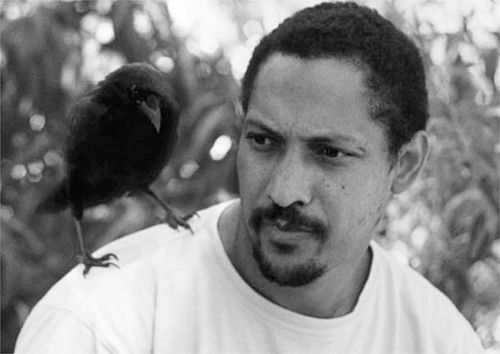
Percival Everett and his pet crow which he has named Jim. The photo was taken by The Paris Review.
The term symbolic interactionalism has been used to express how language and symbols are used in everyday life to give people a sense of society. How we speak is how we relate to the people we encounter what is acceptable and what is not. In short, we give words the meanings they hold. History does not give these meanings, we do. Nigger is bad because we say it is bad. There have been many words which have changed from positive to negative to positive again. For example, gay used to mean happy. Then it became an offensive term for homosexual people. At its height of being an insult, gay was meant to signify anything that could remotely be seen as unattractive, unlikable, or inherently lame. Now the word has been taken back by homosexual people as a term of empowerment.

The same thing can happen with the word nigger. The term nigga can be seen as the beginning phase to change the social meaning of nigger. However, the changing of the word from nigger to nigga has made nigger more powerful. This word is so bad that not even black people can use it. If African-Americans would embrace the word nigger and use it as a rallying call for black power, and white people were not afraid to use the word in a non-racist context, then the power of the word would diminish. As a bi-racial female whose great-great-great-great grandparents were slaves, I am proud to call myself a nigger. Kendrick Lamar writes in his song I about how the word nigger can control the people and condition them to feel fear. He then calls everyone to action to use the word negus. Negus is an Ethiopian word which means black royalty, or a black king. Nigger should mean the same.